
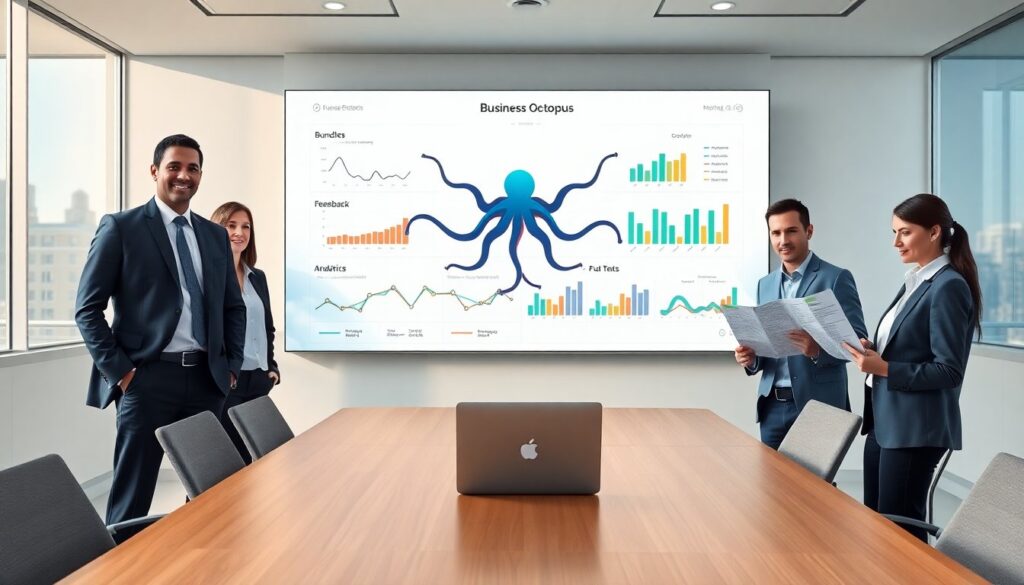
The business growth octopus browsing bundles feedback aheadicona model links bundles, browsing data, and feedback into one loop. It helps firms find buyers, lift conversion, and cut churn. The model treats each channel as an arm. Each arm feeds the central growth engine. Leaders use this model to test offers, refine messages, and scale wins.
Key Takeaways
- The business growth octopus model links bundles, browsing behavior, and feedback to drive revenue and reduce churn effectively.
- Bundles should solve clear customer needs and offer visible savings to boost average order value and retention.
- Browsing data enables personalized customer journeys by matching offers and messaging to user intent in real time.
- Collecting timely feedback helps prioritize improvements that directly increase revenue and strengthens customer trust through transparent communication.
- Integrating bundles, browsing signals, and feedback into a continuous growth loop allows rapid testing, scaling of successful offers, and informed iteration.
- Tracking metrics like revenue per user, bundle attach rate, and repeat purchase rate is essential to validate the impact of the business growth octopus strategy.
What The “Business Growth Octopus” Model Is And Why It Matters
The business growth octopus browsing bundles feedback aheadicona idea compares growth to an octopus with many arms. Each arm acts on a different signal. One arm runs bundles, another reads browsing data, and a third collects feedback. The model matters because it links revenue and learning. It gives teams clear experiments. It reduces waste. It lets teams act fast when an offer works. Teams can scale the offer across channels once they confirm causality.
Optimizing Bundles To Boost Revenue And Retention
Teams test bundles to increase average order value and repeat purchase. The business growth octopus browsing bundles feedback aheadicona approach treats bundles as readable signals. Bundles must solve a common need and sound simple. Teams should price bundles to show clear savings versus single items. They should offer a trial or limited-time discount to shorten decision cycles. Teams should track purchase frequency and lifetime value after a bundle launch to see real impact.
Design Principles For High-Converting Bundles
Teams pick complementary products and label the bundle with a simple benefit. The business growth octopus browsing bundles feedback aheadicona method recommends three rules: pick items customers buy together, show exact savings, and make checkout simple. Teams test multiple bundle sizes and placements. They measure add-to-cart rate and conversion lift per placement. They stop bundles that lower lifetime value and double down on bundles that raise retention.
Using Browsing Behavior To Personalize The Customer Journey
Teams collect browsing signals to personalize content and offers in real time. The business growth octopus browsing bundles feedback aheadicona strategy maps page views, time on page, and click paths to intent scores. Teams show bundles that match high-intent pages. They change product messaging when the browsing pattern shows comparison behavior. They keep privacy controls clear and store only needed signals. They use simple rules and frequent tests to avoid wrong recommendations.
Collecting And Acting On Feedback For Continuous Improvement
Teams ask for feedback at key moments and then act quickly on clear patterns. The business growth octopus browsing bundles feedback aheadicona plan uses short surveys after purchase, quick popup prompts during browsing, and post-support follow ups. Teams tag feedback by theme and by product. They prioritize fixes that affect revenue or high-frequency complaints. They close the loop by telling customers what change they made. This step increases trust and improves future bundle design.
Integrating Bundles, Browsing, And Feedback Into A Measurable Growth Loop
Teams connect bundle tests, browsing signals, and feedback into one loop to drive repeatable gains. The business growth octopus browsing bundles feedback aheadicona loop runs like this: identify a bundle idea from feedback, test it for customers who show relevant browsing behavior, and measure revenue and retention impact. Teams automate the flow where possible. They set short test windows and clear success thresholds. They re-run the loop when results fall or when new feedback appears.
Key Metrics And Tests To Validate Impact
Teams track a handful of clear metrics to prove value. The business growth octopus browsing bundles feedback aheadicona checklist includes: revenue per user, bundle attach rate, repeat purchase rate, churn rate, and net promoter score. Teams run A/B tests for bundle variants and rule-based personalization. They run time-series checks to rule out seasonality. They use cohort analysis to verify long-term lift. They stop and iterate when metrics conflict or when the sample size stays small.